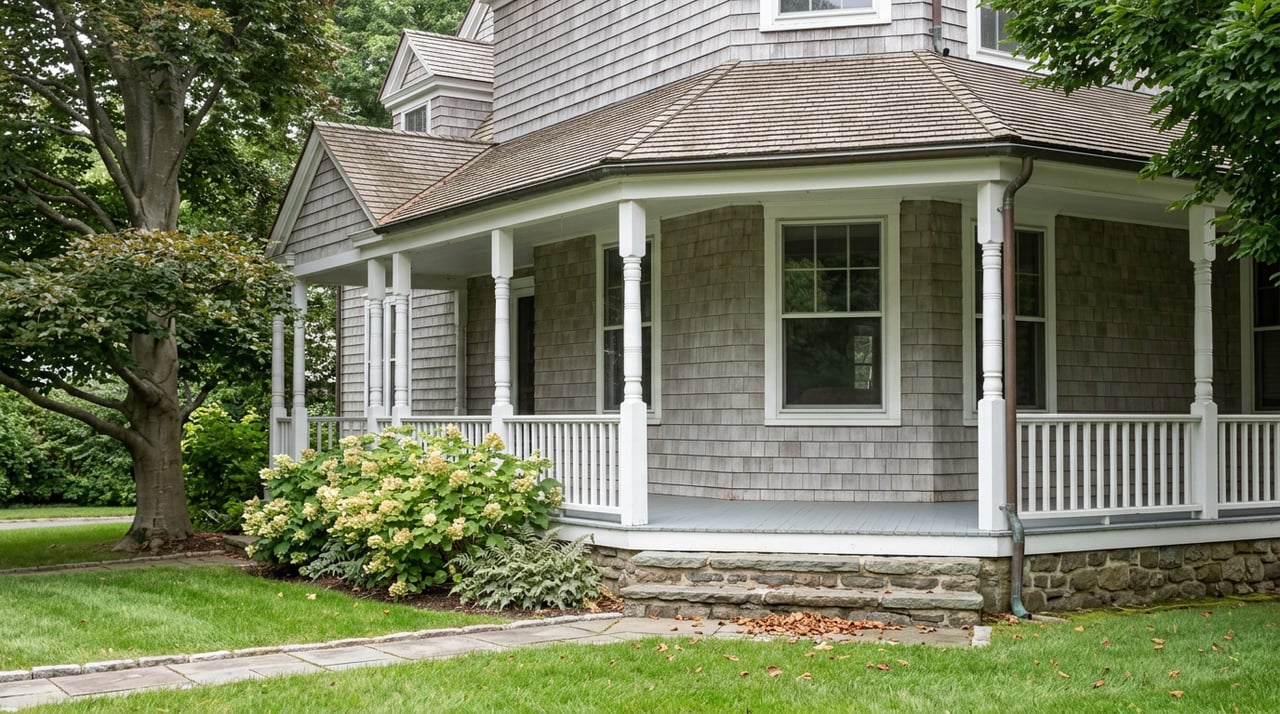
In May 2026, a Greek Revival house on nearly half an acre at 19 Linden Street went on the market for $5.95 million. The listing described it as an opportunity for investors, developers, and owner-occupants to build their dream home. Neighbors read that differently. They saw a wide, buildable lot in Brookline Village and assumed the next step was obvious: buy it, tear it down, put up something bigger.
It is not that simple, and the reason why is worth understanding before you write an offer on any older Brookline property, whether it sits inside a historic district or not. The house at 19 Linden isn't in one of Brookline's nine Local Historic Districts. On paper, that should mean fewer restrictions. In practice, Brookline's senior preservation planner has said the property will almost certainly face an 18-month demolition delay anyway, because it's listed on the National Register of Historic Places. That distinction, between district protection and a delay that can attach to almost any older building in town, is the part buyers routinely miss.
What Actually Trips the Delay
Most people assume Brookline's preservation rules only apply inside the town's designated Local Historic Districts. They don't. Every building in Brookline is potentially subject to demolition delay review. The trigger isn't the neighborhood you're in. It's the scope of the work you're proposing.
A project counts as demolition, for review purposes, once it removes or covers 25 percent or more of a building's exterior sides and roof, removes one full side, removes the roof, or significantly changes the roof's shape. That threshold applies whether you're inside a Local Historic District, in a National Register district, or simply own a house old enough to be considered architecturally significant. Once a demolition or major-alteration permit application is filed, Preservation Commission staff have 10 business days to make an initial determination of significance. If the commission upholds that finding at a public hearing, the delay is imposed automatically.
For 19 Linden, that determination is close to certain. Properties listed on, eligible for, or preliminarily determined eligible for the National or State Register are automatically treated as significant under the bylaw. The 18-month clock isn't a maybe. It's close to a formality.
The Nine Districts, and the Property That Isn't In Any of Them
Brookline's Town Meeting has created nine Local Historic Districts over the decades: Cottage Farm in 1979, Pill Hill in 1983, Graffam-McKay in 2004, Chestnut Hill North and Harvard Avenue in 2005, Lawrence in 2011, Wild-Sargent in 2012, Crowninshield in 2015, and Olmsted-Richardson in 2022. Inside those boundaries, any exterior change visible from a public way needs a certificate from the Preservation Commission before a building permit can be issued.
19 Linden sits outside all nine. The Lindens area, according to the Preservation Commission's own walking tour materials, was the earliest planned development in Brookline, and the house itself was built in 1843 by John Turner, a partner in a Boston dry goods firm. Its most recent owners, Phyllis and Steven Trefonides, bought it in 1976 for $48,500. None of that history sits inside a mapped historic district. All of it still matters to the Preservation Commission, because National Register status carries its own review path independent of local district lines.
Rebecca Moroski, the town's senior preservation planner, has said her office received several calls from prospective buyers asking specifically how the town's demolition rules would apply to this property. Her answer points at what the commission actually wants from a sale like this. She told a Brookline news outlet the commission wants to see people "come in for alterations or additions" rather than full teardowns.
That's not a formality either. It's the stated purpose of the delay itself, buying time for an owner to work out a preservation-minded alternative before a wrecking permit becomes available.
The Clock: 12 Months, 18 Months, and When It Restarts
The length of the delay depends on designation, not location. Here's how the three most common scenarios actually play out.
| Property status | Who reviews it | Delay if found significant | How it ends early |
|---|---|---|---|
| Inside a Local Historic District | Preservation Commission, LHD guidelines apply | Full demolition rarely approved at all | Design review and a Certificate of Appropriateness |
| On or eligible for National/State Register, outside an LHD | Preservation Commission, demolition bylaw | Up to 18 months | Owner works with the commission on an alternative design |
| Neither designation, but deemed architecturally significant | Preservation Commission, demolition bylaw | Up to 12 months | Same, alternative design review |
The delay isn't permanent and it isn't a denial. It's designed to force a conversation. An owner can end it early by submitting a design and going through review, which is precisely the incentive structure the bylaw is built around: work with the town, or wait out the clock.
There's a wrinkle that catches buyers off guard more than the delay itself. If ownership changes hands through an arm's length transfer, or if three years pass without a demolition permit being issued after the significance determination, the review has to restart. Buying a property mid-delay doesn't necessarily inherit a clean slate, and it doesn't necessarily reset the clock in your favor either. It depends on the specifics of the transfer and the timeline, which is exactly the kind of detail worth confirming with the Preservation Commission before you're under agreement, not after.
Two Doors Down, Two Different Outcomes
The clearest picture of how this plays out sits nearby. The sale of 19 Linden followed the sale of two other historic properties, 40 Webster Place and 40 Kent Street, and a development proposal covering both shows both directions the process can take. Under the revised plan, 40 Webster Place will be demolished to make way for a five-story building with 116 micro-dwelling apartments. 40 Kent Street, by contrast, will be restored and converted into a multi-unit building rather than torn down. In a January 2026 letter to the town's Zoning Board of Appeals, the Preservation Commission wrote that it supported the restoration and found the historical documentation offered as mitigation for the Webster Place demolition satisfactory.
That's the bylaw functioning as intended. One building gets preserved because the owner brought the commission an adaptive reuse plan. The other gets cleared because the owner worked through the same review process toward a different outcome. Neither happened quickly, and neither happened without the town's sign-off somewhere in the sequence.
What the Delay Actually Costs a Buyer
The fees themselves are modest. A Certificate of Non-Applicability, issued when proposed work isn't visible from a public way or is a like-kind repair, costs $20. A Certificate of Appropriateness runs on a sliding scale of roughly $2 per $1,000 of estimated project cost. Neither number should scare anyone off.
The real cost is time, and on a property like 19 Linden, time is expensive. An 18-month hold on a $5.95 million lot means carrying taxes, insurance, and financing costs for a year and a half before a demolition permit is even possible, assuming the owner doesn't pursue the alternative-design path the commission clearly prefers. That math changes what "lot value" actually means for a property like this. A buyer pricing the deal purely on land value and rebuild potential, without pricing in the delay, is underwriting a different project than the one they'll actually get to build.
What This Means If You're Pricing a Lot This Year
Brookline's own Preservation Commission has documented that full demolition applications rose 56 percent between 2005 and 2021, a trend the commission itself has linked to development pressure on older housing stock across the town. Its planning staff have noted a pattern worth sitting with: in southern Brookline, smaller historic homes are increasingly replaced by larger single-family houses, while in northern Brookline's denser zoning districts, older single, two, and multi-family buildings are being replaced by larger structures that typically deliver bigger units rather than more of them.
Layer that against where the market sits in 2026. Single-family sales in Brookline closed at an average of roughly $3.04 million across 48 transactions year-to-date, with inventory sitting around 6.7 months of supply, a more balanced condition. Condos moved faster and in greater volume, averaging around $1.38 million across 149 closed sales with a tighter 3.2 months of supply, a seller-favored condition. Demand for larger-lot single-family properties, in other words, remains steady enough that buyers are still competing for exactly the kind of older, larger-lot homes most likely to trigger a demolition delay review in the first place.
That's the piece worth sitting with before you write an offer on a property that looks like a straightforward rebuild. The lot is real. The upside might be real too. But the path from purchase to permit runs through a town commission that has, by its own numbers, been asked to review more demolitions every year, and that reviews every one of them, historic district or not, the same way: does this building matter enough to slow down.
A Few Questions Worth Asking Before You Make an Offer
Does the delay block renovation, or only full demolition? It's triggered by the scope of the work, not the word on the permit. Interior renovation and additions that don't remove 25 percent or more of the exterior or roof generally don't require the same review.
If I buy a property already under a demolition delay, do I inherit the clock or does it restart? It depends on how the sale is structured and how much time has passed since the significance determination. An arm's length transfer of ownership can trigger a fresh review, so this is worth confirming with the Preservation Commission directly before closing.
Does National Register listing alone guarantee an 18-month delay, even without a Local Historic District designation? In practice, yes. Listing on, or preliminary eligibility for, the National or State Register automatically triggers the higher significance finding, which is exactly the situation at 19 Linden Street.
If you're weighing a Brookline property for its land value, its bones, or its next chapter, the Preservation Commission's review process is worth understanding before it becomes a surprise mid-transaction. The Muncey Group works these details into every offer we help write in Brookline and the neighborhoods around it. Schedule a Consultation and we'll walk through what a specific property's history actually means for your timeline and your budget.