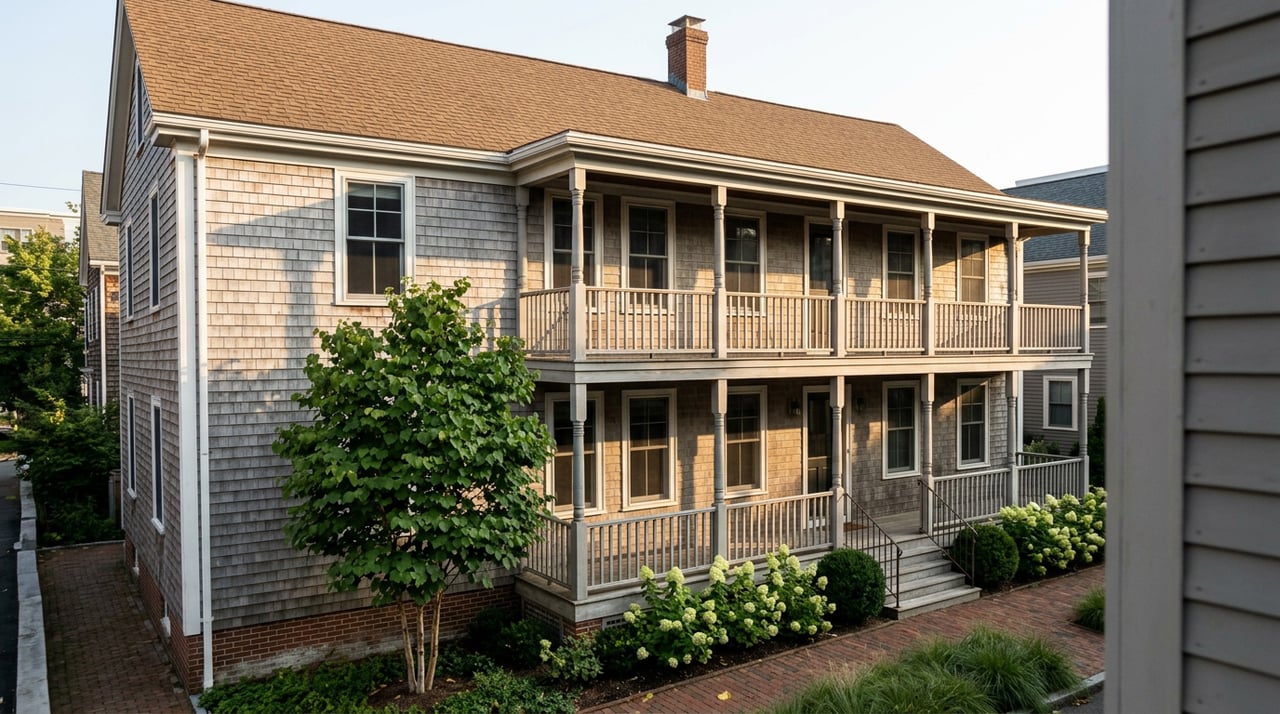
Buyers under agreement on a Jamaica Plain triple-decker condo this month are running into a request that would not have existed a year ago: a formal accounting of the association's reserve fund, complete with bank statements and two years of meeting minutes. For a purpose-built condo with a management company on staff, that is a five-minute email. For a two-unit split on a JP side street, run for two decades on a handshake between the first-floor owner and the second-floor owner, it can be the request that stalls a closing.
That gap is not random. HOA Loan Services reports that, on August 3, 2026, Fannie Mae and Freddie Mac retired the Limited Review process that had covered an estimated 40% of condo transactions nationally, replacing it with a Full Review for most buildings and a narrower Waiver of Project Review for the smallest ones. Jamaica Plain, where the majority of the housing stock consists of converted multi-family buildings split into individual condos, is about to find out which side of that line its triple-deckers land on.
What Changed on August 3, and What Arrives in January
According to the Community Associations Institute, Fannie Mae's Lender Letter LL-2026-03 and Freddie Mac's parallel Bulletin 2026-C, both issued March 18, 2026, rewrote how conventional lenders vet condo associations before approving a mortgage; KSN estimates that these guidelines reach 75% of U.S. condo mortgages written under Fannie Mae standards alone. Three pieces of that rewrite matter most for a JP triple-decker:
- The old Limited Review, which let underwriters approve a loan after a light documentation check, no longer applies to any application dated on or after August 3, 2026.
- According to GoverningDocs, in its place, a project can still skip the heaviest paperwork if it qualifies for a Waiver of Project Review, now open to buildings with 10 or fewer units. Buildings of four units or fewer, which describes nearly every triple-decker conversion clustered near the Stony Brook and Forest Hills Orange Line stops, avoid the extra condition that trips up larger small buildings: five-to-ten unit projects lose the waiver if they are part of a master association or a bigger development.
- Starting January 4, 2027, the minimum reserve contribution required for eligibility rises from 10% to 15% of an association's annual budget, unless the board can point to a reserve study completed within the past three years and is funding at that study's highest recommended level.
Read quickly, that looks like relief for small buildings. A two or three-unit JP conversion should land on the lighter Waiver of Project Review path rather than the document-heavy Full Review that a larger building or a project inside a phased development would now face.
The Twist Is in the Proof, Not the Scrutiny
Here is where that good news runs into Jamaica Plain's actual housing stock. Qualifying for a waiver is not automatic. A lender still has to confirm the building meets the definition, that it is not part of a master association, that the unit count checks out, and that the association can produce enough paperwork for an underwriter to sign off quickly. Retiring Limited Review means every condo purchase now carries more documentation and scrutiny than it did in July, including the ones that ultimately qualify for the easier path.
That is where the gap shows up. Plenty of JP triple-decker conversions were split into condos years ago by an owner who filed a master deed with the county because Massachusetts law requires it, then never formalized much beyond that. Massachusetts General Laws Chapter 183A does require every condominium in the state to keep an adequate reserve fund in an account separate from operating money, but the statute never specifies a percentage or requires a professional reserve study. A two-unit association can be fully legal in Massachusetts and still have no clear paperwork showing how its reserve fund is maintained, no meeting minutes because the two owners settle things in the driveway, and no written budget beyond splitting the water bill.
None of that mattered much under the old Limited Review. It matters now, because even the streamlined waiver path needs enough paper trail to prove the building qualifies for it in the first place.
Why a New Delay Lands Harder on a Market That Was Already Accelerating
Jamaica Plain's condo market picked up speed sharply in early 2026. MLS PIN data through late April showed average time on market for condos had fallen to 25 days, down from 45 days the year before, while active listings climbed to 63 from 49 and pending sales were up 111% year over year. The average condo sale price for the first quarter came in at $738,400, up 4.6% from a year prior, even as closed sales dipped slightly on the usual lag between a signed offer and a completed closing.
A neighborhood that was closing deals in three and a half weeks earlier this year has little built-in tolerance for a financing snag that did not exist a year ago. A buyer who loses two or three weeks assembling reserve statements and minutes the association never kept in organized form is not just facing an inconvenience. They risk a rate lock expiring, a contingency deadline passing, or a seller entertaining a backup offer while the paperwork gets sorted out. On the value side, legal analysis of the new standards estimates that an association that loses eligibility for conventional financing altogether, a status lenders call unwarrantable, can see unit values drop somewhere between 5% and 30% simply because the pool of buyers who can get a mortgage shrinks.
What to Do Before You List or Offer
For sellers, the fix is mostly about timing. Pull together the last two years of meeting minutes, a current reserve account statement, and a plain accounting of the annual budget before the building goes on the market, not after an accepted offer triggers the lender's request. If the association has never held a formal meeting or kept clear records for its separate reserve account, both issues are simple enough to address in a weekend and worth handling before the listing photos go up.
For buyers, ask these questions before writing an offer on a JP triple-decker condo:
- How many units are in the building, and is it part of any larger association or phased development?
- Does the association keep its reserve fund in an account separate from operating expenses, as Massachusetts law already requires?
- Can the seller produce two years of meeting minutes and a current budget, even if the association has never used the word formal to describe itself?
If the answers come back thin, that does not mean the deal is dead. It means building extra time into the contract for a lender's review, and it may mean a cash offer carries more leverage than it did a year ago.
Straight Answers for JP Buyers and Sellers
Does any of this apply if I am paying cash? Not directly.
My building has two units and no formal HOA name. Is it even a legal condo? Likely yes, as long as a master deed was recorded with the county under Massachusetts General Laws Chapter 183A when the building was converted. Recording that deed is what makes a condo legal in Massachusetts. Whether the association has minutes, a budget, or a reserve study is a separate question from whether the condo itself was validly created.
Will my two-unit building definitely get the Waiver of Project Review? Buildings of four units or fewer are not subject to the master-association restriction that can disqualify larger small buildings, which is a good sign. The guidance is new enough that individual lenders are still working out exactly how they apply it, so confirm directly with your loan officer rather than assuming.
If you are weighing a Jamaica Plain triple-decker condo purchase or getting one ready to list, Muncey Group can walk through what your specific building's paperwork looks like before it becomes a closing-week surprise. Schedule a Consultation to talk through your building, your timeline, and what a lender is likely to ask for.
This article is general information, not legal, tax or financial advice. Consult a qualified professional about your situation.